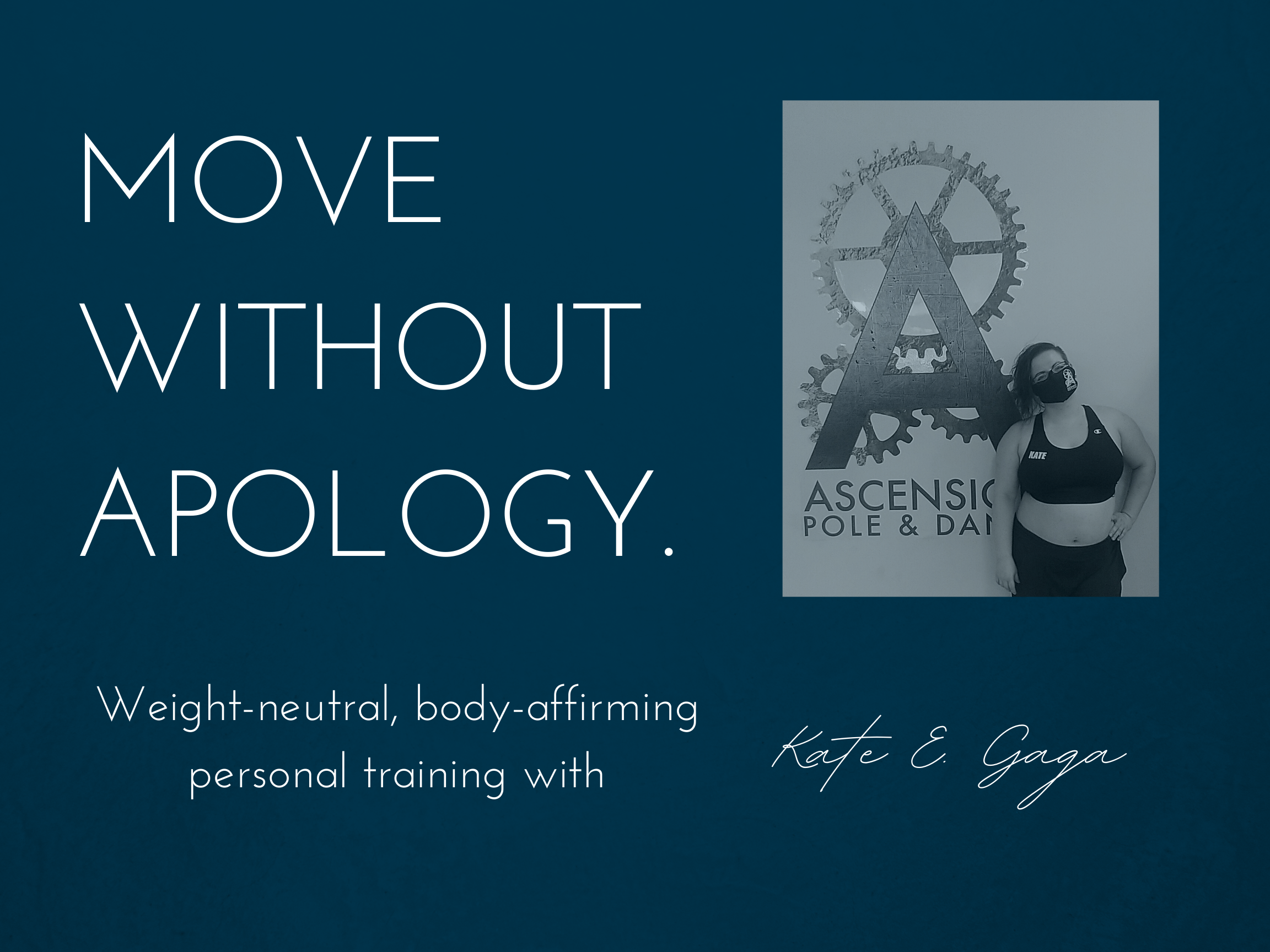
Looking back, it isn’t that surprising.
From enjoying song and dance from a young age, not fitting the profile for a ballet dancer, and joining both a Hungarian Folk Dance company and a Scottish bagpipe band before the age of 15, Kate has always had a taste for making an audience cheer, laugh, and “ewww…”.
A classic Meyers-Briggs ENTP, Kate has dabbled in many interesting hobbies and art forms, including becoming a pirate at a renaissance fair, developing a teenage drag king persona, coaching a collegiate synchronized swimming team, and memorizing popular music video choreography down to the last hip thrust.
Starting as a teenager in Ohio, Kate spent several years developing and leading physical and artistic activities with youth and adults who had a physical or cognitive disabilities. When Kate was 16, they decided that they would one day open an dance studio that was able to teach all bodies to dance. Read that again. Kate believes that with adaptations there can be a studio that isn’t “special” for only folks experiencing accessibility issues, but with universal design and personal modifications in mind.
With that goal in mind, Kate entered college as a pre-Physical Therapy/pre-Med student. After finding they had a wide range of interests in human health and movement beyond just PT, Kate graduated with a degree of their own design: A Bachelor of Specialized Studies (B.S.S.) in Holisitc Health Sciences, or as Kate says “the health of the whole human”. While their graduate education led them to work in a less-physical environment for almost a decade, Kate actively continued to seek out learning about human movement, emotional intelligence, teaching, and development all along the way. Kate’s resume now boasts multiple licenses and certifications in movement, teaching, training, coaching, and supervision.
Kate opened Ascension Pole and Dance in Boise in July 2018, and fosters a community of humans who cheer each other on in moving their bodies, without apologies.
*Kate E. Gaga identifies as genderqueer/gender non-comforming and uses the singular pronouns they / them / their.
 kate e gaga